Insights & News | updates
Reflections from the EBR Network Conference: why valuable research matters for evidence-based healthcare
02/01/2026 | Tiziano Innocenti

I recently had the opportunity to participate in the Evidence-Based Research (EBR) Network Conference (Bergen, 19-21Novembre 2025) as a member of the EBR Network Steering Committee, where I serve as liaison for the Editorial Subcommittee. The conference offered a timely and intellectually rich space to reflect on some of the most pressing challenges facing contemporary research: not only how we produce evidence, but whether the research we conduct is genuinely necessary, ethical, and fit for purpose.
The EBR Network is built around a straightforward principle: no new research studies should be initiated without a prior systematic review of existing evidence. In practice, this means treating the systematic and transparent use of prior research not as a methodological “extra”, but as the starting point for decisions about what research should be done, how it should be designed, and why it matters.
Beyond methods: the centrality of valuable research
A recurring theme throughout the conference was the concept of valuable research. This goes beyond methodological rigour alone and encompasses relevance, transparency, ethical justification, and alignment with what is already known. Many discussions returned to a fundamental, yet often neglected, question: does this study need to be done at all?
Undertaking research without systematically considering what has been done before is widely recognised as unethical, unscientific, and wasteful. Despite decades of progress in evidence synthesis and reporting standards, there remains a persistent gap between existing knowledge and the questions addressed by new primary research. The EBR Network’s agenda places this issue at the centre, advocating not only for the appropriate use of systematic reviews to inform new studies, but also for the efficient production, timely updating, and wide accessibility of systematic reviews themselves.
Placing new evidence in context
Another strong message, echoed across sessions, was that the responsibility of researchers does not end with publishing results. New findings should be explicitly placed in the context of prior evidence and, where feasible, incorporated into an updated systematic review. This is not only good scientific practice; it is part of what makes research usable—and, ultimately, valuable for patients, clinicians, and decision-makers.
Signals from the conference: culture, incentives, and responsibility
The conference highlighted several cross-cutting messages that resonate strongly across disciplines and contexts. First, improving research quality cannot rely solely on better tools or guidelines. Cultural and structural factors - such as academic incentives, career progression metrics, and funding priorities - play a decisive role in shaping research behaviour. Without addressing these upstream determinants, technical solutions risk having a limited impact. Second, the conference underscored the importance of integrating ethical reflection into research design, not as a procedural requirement but as a substantive component of responsible science. Ethical research is not only about participant protection; it is also about ensuring that studies address meaningful questions and generate knowledge that can plausibly inform practice or policy. Third, there was strong attention to issues of equity and global relevance. Several contributions emphasised the importance of embedding evidence-based research principles in low-resource settings, recognising both the risks of duplication and the opportunity to strengthen local research capacity through better use of existing evidence.
The value of networks and editorial responsibility
One of the distinctive strengths of the EBR Network lies in its role as a community working to make evidence-based research part of research culture across disciplines. Through its Steering Committee, Special Interest Groups, and engagement with journals and editors, the Network helps translate principles into concrete actions. The editorial dimension is particularly relevant. Journals remain powerful gatekeepers of research norms, and aligning editorial policies with evidence-based research principles is an essential lever for change—especially when it comes to expectations around the use of prior evidence, transparency of reporting, and the positioning of new results within the cumulative research record.
Natural synergies with evidence-based healthcare
Many of the issues discussed at the EBR Network Conference closely intersect with the broader evidence-based healthcare (EBHC) agenda. If EBHC is concerned with the appropriate use of evidence in clinical and policy decision-making, EBR focuses on the quality and relevance of the evidence entering that pipeline in the first place. These are not separate enterprises, but complementary components of the same ecosystem. Challenges such as poorly justified trials, selective reporting, misaligned incentives, and limited clinical relevance ultimately undermine the foundations upon which evidence-based decisions are built. Strengthening EBHC therefore requires sustained attention to evidence-based research principles upstream, starting from the systematic, transparent use of what is already known.
Looking ahead
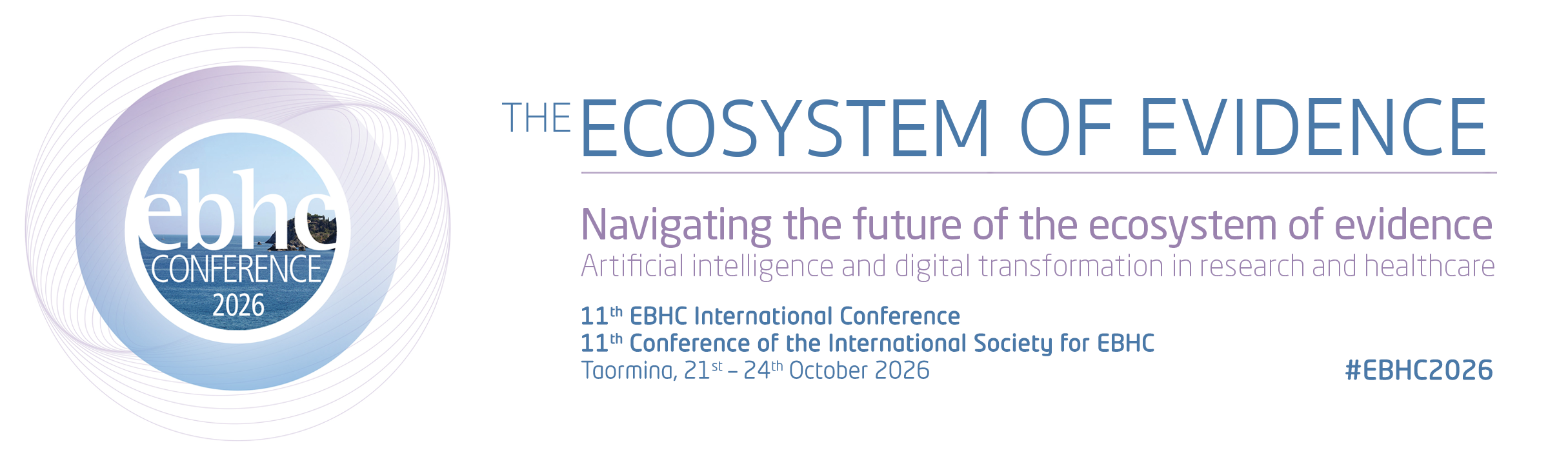
The EBR Network Conference reaffirmed the value of creating spaces for critical reflection on how research is conceived, conducted, and evaluated. In an era marked by rapid technological change and increasing demands on research to deliver societal value, a world in which decisions about research are routinely based on transparent and systematic use of evidence is not an aspiration for the distant future: it is a practical direction of travel. These priorities also speak directly to the evidence-based healthcare community. The 11th EBHC International Conference (Taormina, 21–24 October 2026) will be an important opportunity to continue this dialogue—connecting those who work on the upstream determinants of research quality with those who rely on evidence to inform clinical practice, policy, and wider health decisions—so that innovation is built on research that genuinely deserves to shape care.
Don't miss any updates from the EBHC International Conference!
Subscribe to our newsletter by filling out the form.